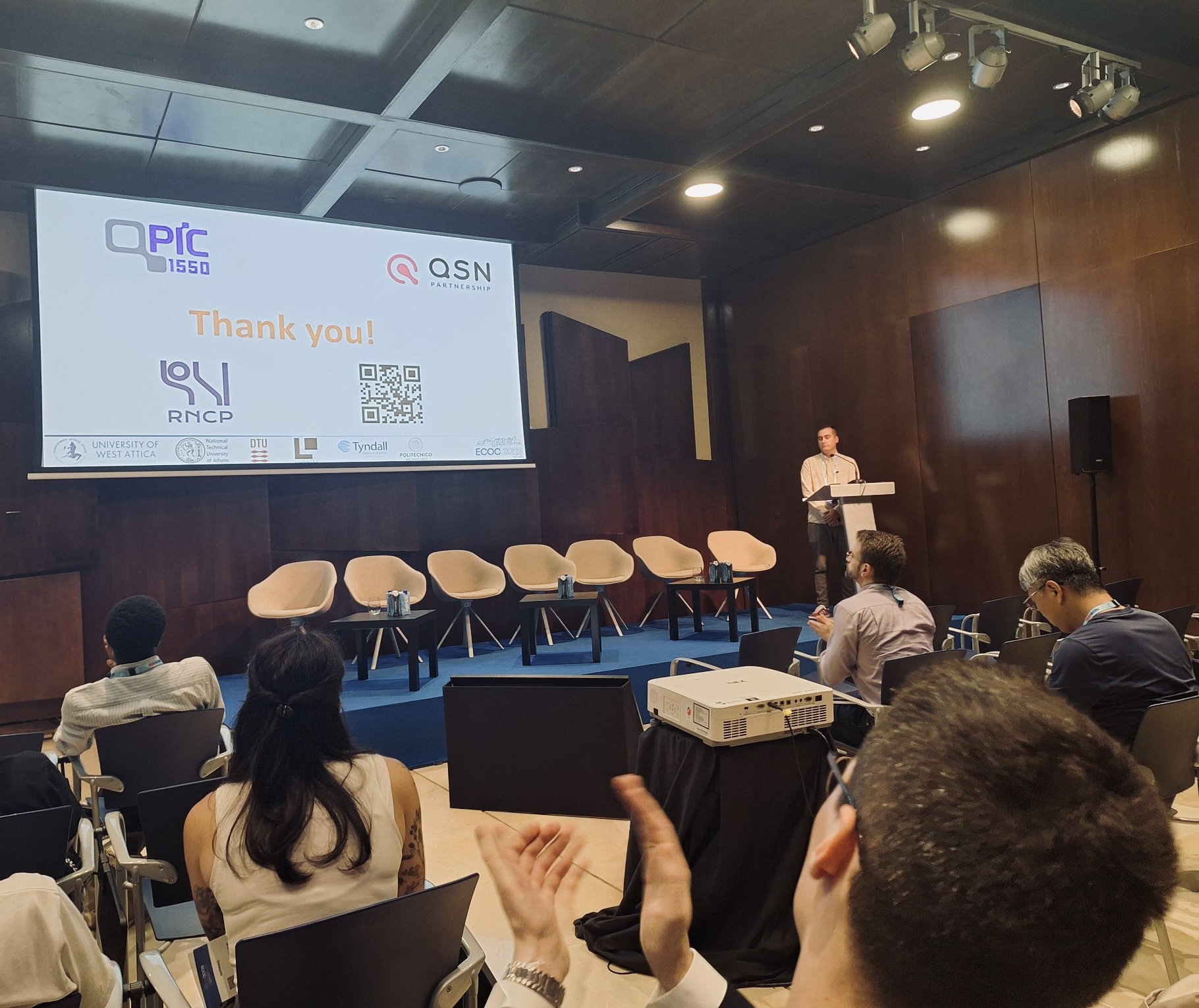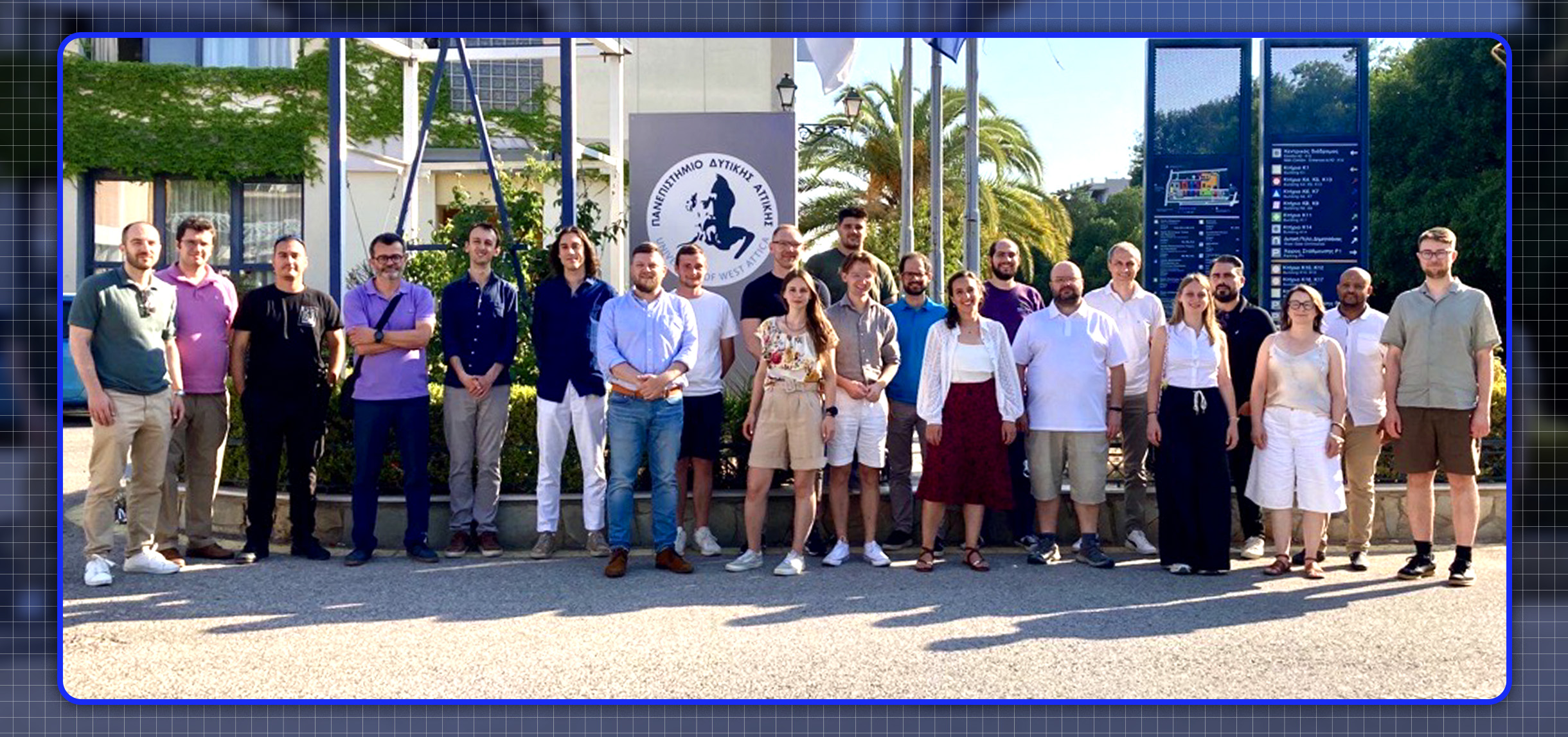

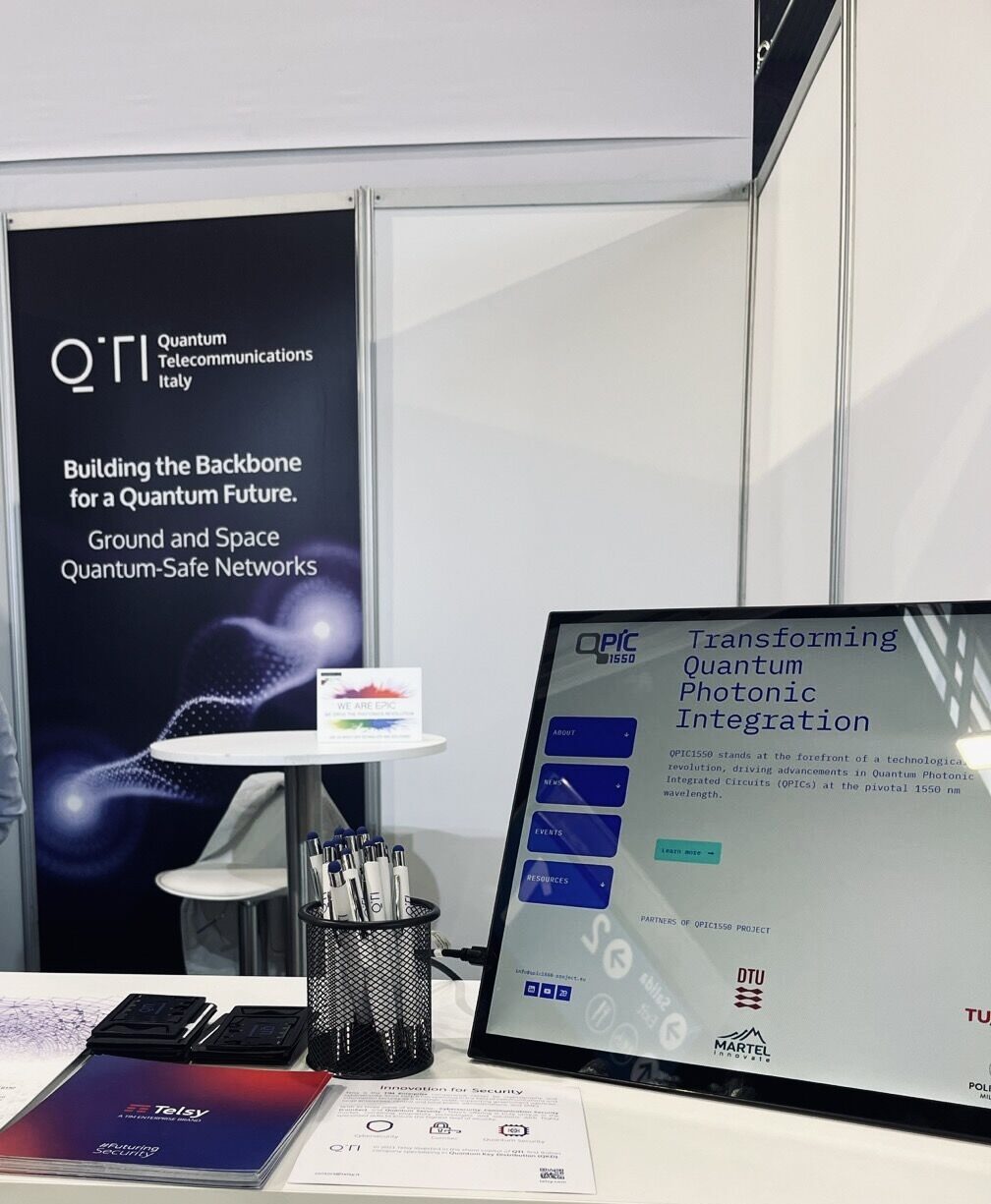
Project partners from the University of West Attica (UWA), Technical University of Denmark (DTU), and QTI srl represented the QPIC1550 consortium at the European Conference on Optical Communication (ECOC 2026) in Málaga, Spain. As Europe’s largest and most prestigious event on optical communications, ECOC offered an ideal platform to showcase recent advancements in scalable, telecom-compatible quantum photonic circuits.
QPIC1550 partners contributed across multiple sessions with high-impact presentations:
- Towards Scalable Quantum Clock Synchronisation Networks with Low-Cost Single-Photon Avalanche Detectors and High-Brightness Photonic Integrated Entangled Pair Sources (Contributed Talk – Kostas Sozos, UWA): Presented progress in quantum clock synchronization using QPIC1550 devices, featuring micro-ring resonator (MRR)-based entangled-pair sources.
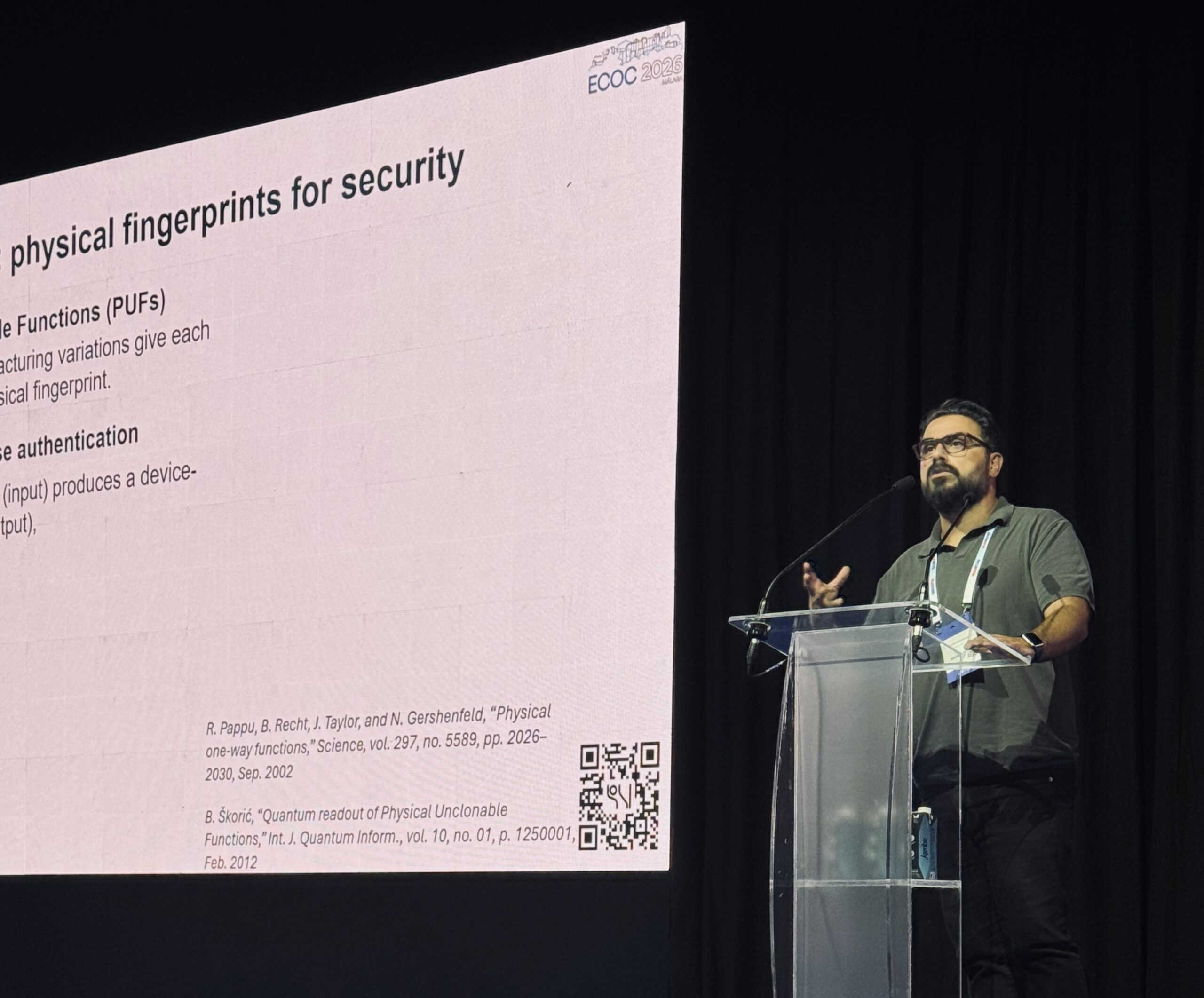
- Quantum Readout based on Silicon Photonic Integrated Circuits for Enhanced Security (Contributed Talk – Charis Mesaritakis, UWA): Demonstrated silicon photonic readout systems integrated on the QPIC1550 mesh platform for Physical Unclonable Function (PUF)-based security applications.
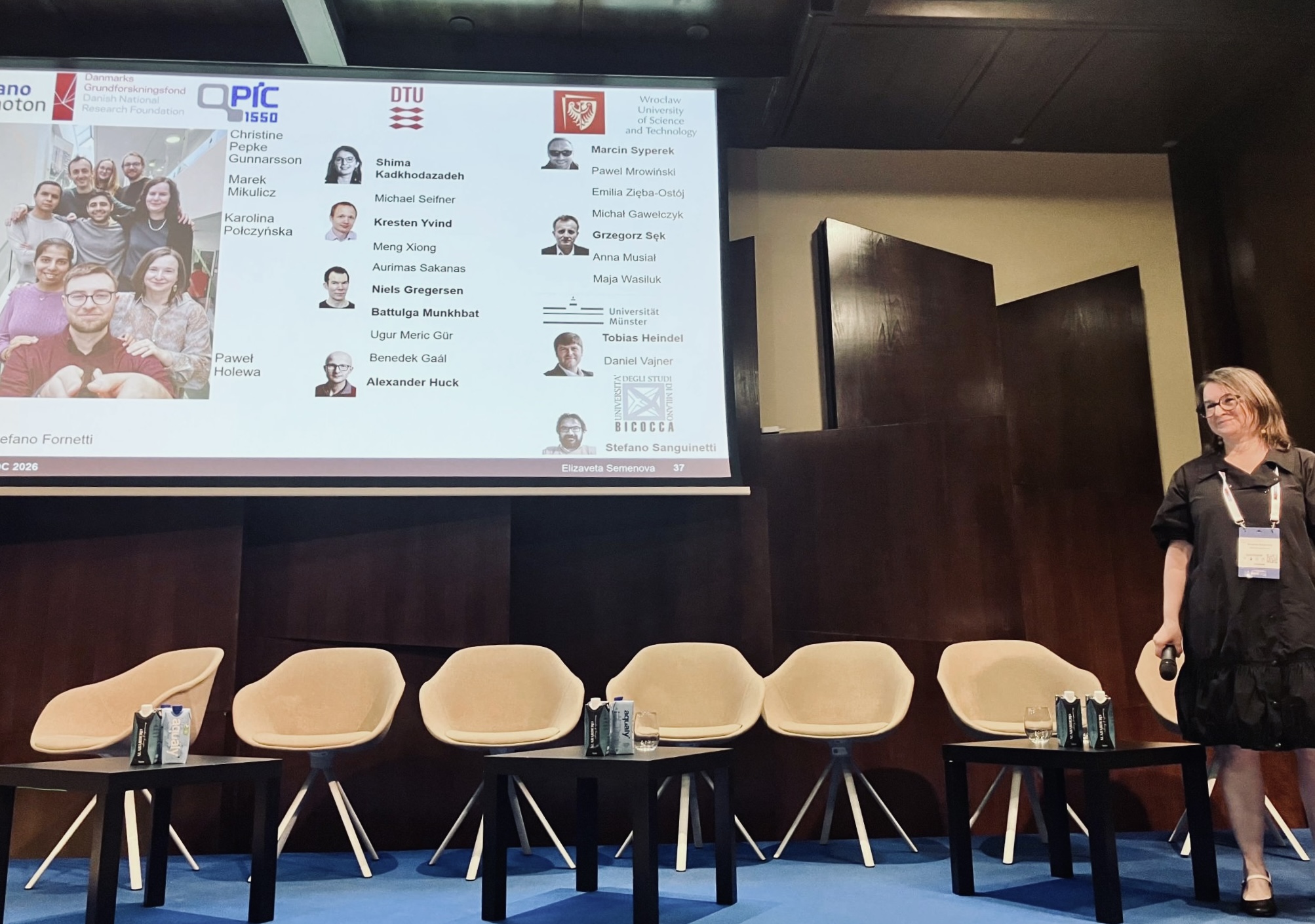
- Engineering Deterministic Quantum Light Sources at Telecom Wavelengths (Invited Talk – Elizaveta Semenova, DTU): Addressed key bottlenecks in deterministic telecom quantum light sources, detailing InAs/InP quantum dot epitaxy, Stark tuning, site-controlled growth, and deterministic cavity fabrication to achieve high yield, tunability, and single-photon purity.
- Long-Distance Entanglement Distribution Between Integrated Silicon Photonic Chips (Contributed Talk – Damien Roux, DTU): Reported chip-to-chip entanglement-based Quantum Key Distribution (QKD) over an 80 km multicore fiber link, achieving an 85.7% Bell state fidelity and 2.03 bits/s secure key rate through phase-locked loop stabilization.
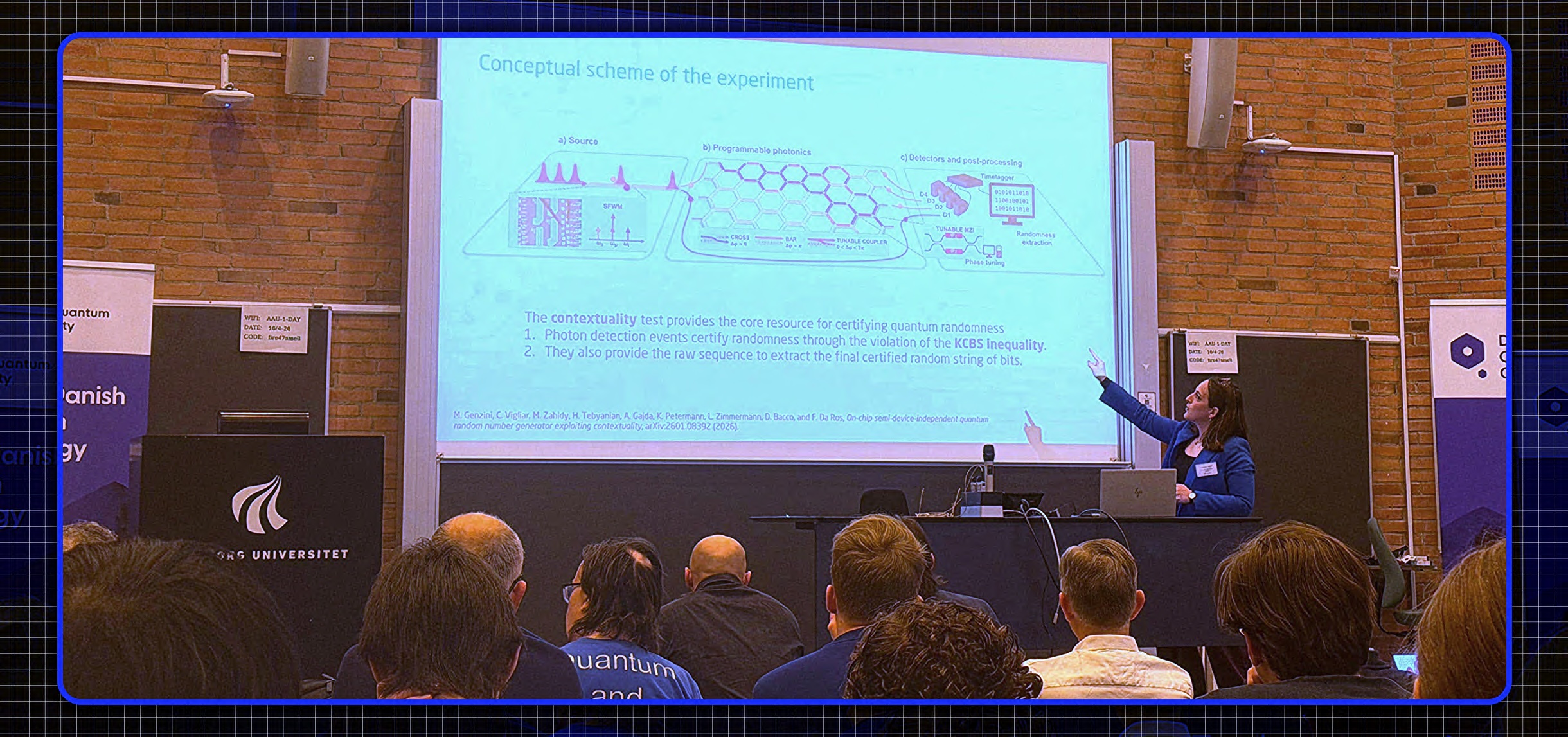
- Contextuality Based Integrated Semi-Device Independent Quantum Random Number Generator (Contributed Talk – Maddalena Genzini, DTU): Demonstrated an integrated semi-device-independent quantum random number generator (QRNG) on a programmable photonic circuit based on contextuality. By executing a KCBS inequality test, certified genuine randomness was achieved at an extractable rate of 0.077 bits per round, paving the way for scalable, chip-based certified QRNGs.
- Measurement-Based Quantum Kernel Method for Data Classification on a Reprogrammable Silicon Photonic Device (Contributed Talk – Veronika Raschendorfer, DTU): Demonstrated a measurement-based quantum kernel estimation protocol on a reprogrammable silicon photonic chip using path-encoded four-qubit graph states, achieving 90% classification accuracy and providing a scalable, noise-resilient framework for quantum machine learning.
Throughout the week, the presentations drew strong audience engagement and prompted technical discussions with industry and academic peers. These results demonstrate that complex quantum functions, ranging from secure key distribution over long distances to precision synchronization and chip-level physical security, can be successfully transitioned onto scalable, integrated photonic platforms. By proving these capabilities directly at 1550 nm, QPIC1550 is actively bridging the gap between laboratory quantum physics and real-world deployment over existing fiber-optic networks.